
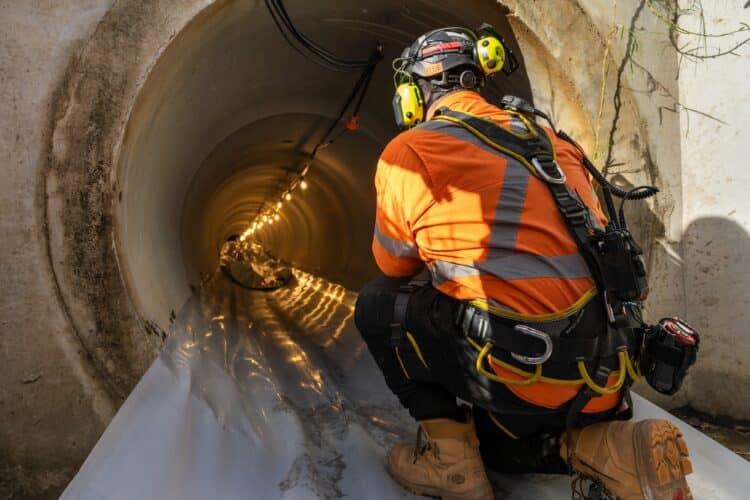
Across Australia and New Zealand buried water infrastructure is steadily approaching the end of its intended service life.
Trenchless renewal has become an essential strategy for extending asset performance while minimising disruption to communities, reducing environmental impact and lowering whole-of-life costs compared with traditional excavation and replacement.
The region has demonstrated strong capability in adopting modern trenchless technologies, for cleaning, inspection, repair, and renewal of ageing pipeline infrastructure.
Yet despite decades of technical advancement, the sector still operates without a unified framework for liner design or a consistent approach to defining technical service life.
Across projects in Australia and New Zealand, designers typically reference a combination of engineering guidance including AS/NZS 2566.1 alongside international standards such as ASTM and DWA, supplemented by authority specifications and project-specific engineering approaches.
This layered system works in practice, but it is not unified. The result is that liner thickness, structural assumptions and declared service life can vary significantly between projects addressing very similar conditions.
The issue is not technical capability. It is consistency.
A complex design landscape
Trenchless rehabilitation projects involve a broad range of stakeholders including asset owners, designers, contractors and manufacturers.
Each operates within different risk frameworks and decision-making pressures.
Asset owners must consider long-term infrastructure performance and public accountability.
Designers require defensible engineering compliance. Contractors focus on constructability and programme certainty, while manufacturers balance material performance, innovation and economic feasibility.
These priorities inevitably influence how conservatively a liner is specified.
Warranties, defects liability periods, insurances and indemnities further shape the design environment. Construction risk, quality assurance requirements and long-term monitoring expectations all play a role.
Where uncertainty exists, the industry often manages risk through conservative design assumptions.
When uncertainty drives over-speculation
Designs are frequently developed using worst-case assumptions.
Thoroughly verifying host pipe conditions, groundwater and loading scenarios can be costly and complex, so conservative parameters are commonly applied.
While precaution reduces perceived risk, it can also introduce unintended consequences.
Over-specification increases material use, can reduce hydraulic capacity and may introduce unnecessary cost across the life of an asset.
Sergej Fast, Technical Manager at Pipe Core, says taking a closer look at site conditions and how pipes actually fail can lead to more practical design outcomes.
“Good engineering starts with understanding how and why a pipe fails,” Fast said. “When you look at the condition of the existing pipe, the actual groundwater conditions, and whether loads are temporary or permanent, you can often design more efficiently while still keeping the right safety margins.”
Fast adds that the industry already has the capability to do this well. “It’s not really a knowledge issue, it’s about being consistent in how we interpret and apply it across different projects.”
Product design: efficiency with integrity
From a product development perspective, liner design generally focuses on three core objectives: achieving structural performance with material efficiency, ensuring reliable installation in real-world conditions and reducing life-cycle environmental impact.
These objectives align closely with the broader sustainability ambitions now influencing infrastructure procurement across Australia and New Zealand.
However, when projects default to conservative assumptions or inconsistent interpretation of standards, opportunities to optimise material use and environmental performance may be constrained.
Katharina Helming, Business Development Manager at SAERTEX multiCom®, said manufacturers play an important role in supporting design decisions with transparent technical data.
“Service life expectations should be supported by recognised testing methodologies so designers and asset owners can clearly understand the technical basis behind those claims,” Helming said.
Helming notes that some manufacturers have undertaken extensive long-duration testing to demonstrate long-term material behaviour.
“For example, SAERTEX multiCom® has conducted long-term testing on its products,” she said.
“SAERTEX multiCom® recently conducted further testing, including extending the 10,000-hour test to 24,000 hours and increasing abrasion testing in the Darmstadt tilting test from 100,000 to 300,000 load cycles to simulate more severe conditions. These expanded programs provide a broader data set supporting an expected a technical service life of 50 or up to 100 years depending on the product used.
“Testing at this scale provides empirical evidence that can help support technical service life expectations.”
Declaring technical service life
Perhaps the most fragmented aspect of trenchless rehabilitation is how technical service life is declared.
Across the market, design life is typically expressed through a combination of recognised testing standards, mathematical extrapolation, engineering judgement and, at times, market positioning.
Without consistent methodology, comparing service life claims between products or projects can be difficult.
In some cases, claims of a “100-year liner” are presented without clear explanation of the testing regime or assumptions used to derive that figure.
For the industry to maintain credibility, service life claims should be transparent and traceable to verifiable evidence. Long-term testing regimes — such as creep rupture testing exceeding 20,000 hours — can provide valuable insight into material durability.
When these results are clearly documented and linked to recognised standards, they allow engineers and asset owners to assess performance with greater confidence.
Importantly, the goal is not to reduce safety factors or diminish engineering conservatism. Rather, it is to ensure design decisions are supported by clear evidence and consistent interpretation.
Moving toward industry alignment
Encouragingly, efforts are emerging within Australia and New Zealand to bring greater structure to liner design methodologies.
The ASTT Specification for Structural Lining of Pipelines provides a practical baseline for design assumptions, material properties and engineering verification processes.
While not intended to replace existing standards, it offers structured guidance that can support greater transparency and comparability between projects.
Documents such as this help create a common engineering language for trenchless rehabilitation.
Consistency in design interpretation benefits every participant in the supply chain — from asset owners and consulting engineers through to contractors and manufacturers.
More importantly, it strengthens confidence in the long-term performance of rehabilitated infrastructure.
A practical path forward
The trenchless sector across Australia and New Zealand is technically strong. It has demonstrated its ability to deliver innovative solutions that extend the life of critical underground infrastructure.
What the industry increasingly needs now is alignment.
Greater transparency around testing methodologies, clearer documentation of service life assumptions and more consistent interpretation of engineering standards will help support informed decision-making across projects.
Manufacturers, engineers and contractors all have a role to play in this process. When service life claims are supported by recognised testing regimes, when design assumptions are clearly documented and when specifications are applied consistently, trenchless renewal can deliver not only cost and environmental benefits but also long-term infrastructure certainty.
As rehabilitation programs continue to expand across Australia and New Zealand, the opportunity is clear: move from fragmented interpretation toward a shared commitment to evidence-based infrastructure renewal.
Jason Marshall,
CEO Pipe Core, ASTT Councillor