

Recore Pipe Relining Specialists have delivered a challenging 20-metre relining project beneath Maraetai Power Station.
Working deep below Maraetai Power Station on New Zealand’s Waikato River, Recore Pipe Relining Specialists has successfully completed a complex 20-metre rehabilitation of a DN250 overflow drainage line under demanding access, security and operational conditions.
Maraetai is the largest hydroelectric power station on the Waikato River, with a generating capacity of 360 MW. For the Recore Pipe Relining Specialists crew, working within such a significant piece of infrastructure brought challenges well beyond those encountered on a conventional relining project.
The scope involved rehabilitating a 20-metre section of DN250 overflow drainage line associated with one of Maraetai II’s penstocks, which are approximately 100 metres long and 4.6 metres in diameter, running through to the drainage gallery beneath the power station.
The work area was located several storeys below ground and below the surrounding water level, meaning every element of the project – from personnel movements to equipment selection and installation methodology – had to be carefully considered.
Access was one of the first major challenges.
Strict site-security requirements added another layer of complexity. Crew members passed through multiple controlled checkpoints, presenting identification and using access fobs as they progressed through the facility.
Emergency procedures were equally stringent, reflecting the unique environment in which the crew was operating.
All equipment had to be lowered from ground level into the drainage gallery using one of the power station’s original gantry cranes. Equipment was transferred through openings approximately 1.5 metres wide and lowered four storeys into the work area.
This immediately ruled out larger and less manoeuvrable equipment.
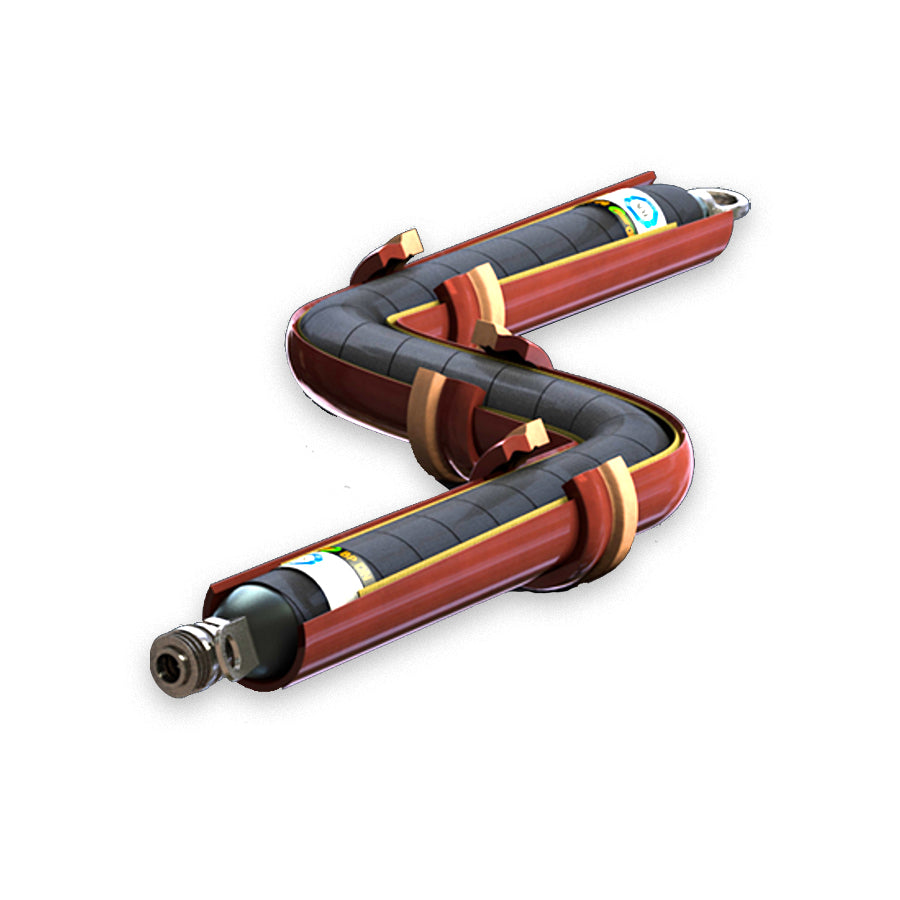
Recore Pipe Relining Specialists selected a Picote Aqua Maxi Miller for cleaning, together with a UV XAIR curing system and inversion drum, UV liner and resin from UV Relining, all supplied by Pipe Core.
The compact footprint of the equipment proved particularly valuable in navigating the restricted access.
Once inside the gallery, the crew was operating in an environment surrounded by reminders of the infrastructure above and around them. Warning signage throughout the facility identified the tailwater level, with the crew operating several floors below this level.
Making every hour count
The works required the relevant flow to be stopped, placing additional importance on completing the rehabilitation efficiently and minimising the time the infrastructure remained offline.
Recore Pipe Relining Specialists responded by dividing the crew and carrying out key stages of the project simultaneously.
While one group worked within the power station cleaning and preparing the host pipe, another prepared the UV liner offsite at the Recore Pipe Relining Specialists facility. The liner was prepared under controlled, shaded conditions before being transported to site ready for installation. Because curing is initiated by UV light, the impregnated liner could be prepared in advance and safely transported while protected from sunlight.
This allowed both stages of the project to progress simultaneously, helping the crew maximise the available outage window.
Cleaning of the deteriorated pipe was completed in half a day using the Picote Aqua Maxi Miller, a high-speed multi-use machine for water main cleaning and milling.
The pipe was severely deteriorated in sections, requiring the crew to remove fittings around a 90-degree bend to clear accumulated debris before conducting a CCTV inspection and completing final preparation for lining.
Once onsite, the liner was loaded into the UV Relining inversion drum ready for installation.
Final measurements could then be entered into the UV XAIR system immediately before curing, with the installation monitored and logged through the system’s smart installation surveillance technology.
Technology suited to the site
With space at a premium, equipment selection played an important role in the success of the installation.
The UV XAIR was positioned within the drainage gallery itself, allowing the crew to establish the curing operation close to the pipe while working within the tight physical constraints of the facility.
Pipe Core also provided onsite technical support during the project, working alongside the Recore Pipe Relining Specialists crew through the installation and curing process.
The project involved four Recore Pipe Relining Specialists crew members and two Pipe Core personnel onsite, bringing together the contractor’s relining capability with specialist product and equipment knowledge for what was an unusual and technically demanding application.
All personnel entering the work area were required to hold appropriate confined-space qualifications, while the crew also operated under the power station’s stringent access and safety requirements.
Despite the difficult environment, restricted access and the need to minimise downtime, the rehabilitation was successfully completed.
For Recore Pipe Relining Specialists, the project represents more than the successful relining of a 20-metre section.
It demonstrates what can be achieved when trenchless technology is applied to infrastructure in places where conventional replacement would present significant logistical challenges.
The successful outcome has also created the potential for further rehabilitation work across additional penstocks at the power station.
For Pipe Core, the project reinforced the value of matching equipment to the realities of a site rather than simply to the diameter and length of the pipe.
In this case, the manoeuvrability of the Picote Aqua Maxi Miller, combined with the flexibility and compact footprint of the UV XAIR system and UV-cured liner solution, allowed the crew to take trenchless rehabilitation deep beneath one of New Zealand’s most important hydroelectric facilities.
For Recore Pipe Relining Specialists, it was a significant milestone – and a compelling demonstration of trenchless technology reaching infrastructure that would otherwise be extraordinarily difficult to repair.